
Acoustic Privacy and Speech Privacy: How to Protect Sensitive Data in the Office

When we think about protecting sensitive data, firewalls and encryption are usually the first things that come to mind. Yet there’s a physical vulnerability that’s easy to overlook: the human voice.
In a modern office, noise control isn’t just about comfort or cutting down distractions — acoustic privacy is a genuine compliance requirement, not a wellbeing add-on. In many offices, confidential conversations can be understood from surprising distances, and that’s a vulnerability GDPR doesn’t overlook. That’s why speech privacy has become a cornerstone of office design: it stops confidential information — legal, medical or commercially sensitive data — from being overheard by unauthorised staff or outside visitors.
In this article, we’ll look at the binding link between acoustics and data protection law, the scientific benchmarks used to measure speech privacy, and the integrated solutions that can lock down your workspace — all as part of a sound approach to office acoustic design.
The Link Between Acoustics and Data Protection (GDPR)
Managing acoustic privacy is a compliance obligation in its own right. The General Data Protection Regulation (GDPR) requires organisations to put in place appropriate technical and organisational measures to ensure data security (Article 32 GDPR) and to uphold the core principle of integrity and confidentiality (Article 5(1)(f) GDPR). Guidance from the European Data Protection Board (EDPB) on technical security measures confirms that physically securing the spaces where data is processed falls squarely within the “appropriate measures” required under Article 32.
This obligation isn’t limited to protecting digital files or paper records — it extends to every piece of information handled by the business, including what’s said out loud. When a conversation involving sensitive data — in a boardroom or an executive office, say — can be clearly heard from outside, that’s a vulnerability equivalent to a genuine data breach. This is where acoustic privacy becomes a pillar of corporate compliance: sound-absorbing treatment is no longer just a matter of comfort, it’s an essential safeguard for keeping confidential discussions within the authorised physical space.

How Do You Measure Acoustic Privacy in a Workplace?
Assessing speech privacy in an office isn’t a matter of guesswork — it relies on internationally recognised technical standards. The key metric is the Speech Transmission Index (STI), defined by the IEC 60268-16 standard, which quantifies how intelligible a conversation is to someone who isn’t part of it.
In an untreated open-plan office, conversations can remain perfectly intelligible up to 8-10 metres away, with average STI values between 0.55 and 0.65 — a genuine risk for any organisation handling confidential data.
STI Levels and Acoustic Privacy Ratings
- STI > 0.60 (privacy at risk): speech is crisp and easy to follow. In an untreated open-plan space, intelligibility can reach 8-10 metres, completely undermining confidentiality.
- STI between 0.20 and 0.45 (safe zone): speech is perceived only as indistinct background murmur. Individual words can’t be made out. This is the recommended benchmark for shared offices.
- STI < 0.20 (excellent acoustic privacy / full confidentiality): conversations remain fully private. This is the standard required for critical spaces such as executive offices, boardrooms and law firms.
In highly reverberant spaces (hard surfaces), sound waves travel further, keeping speech clear even at a distance. Targeted acoustic treatment reduces this spread, turning clear speech into indistinct background noise for anyone outside the intended listening area.
The LvB Italia Approach: From Comfort to Confidentiality
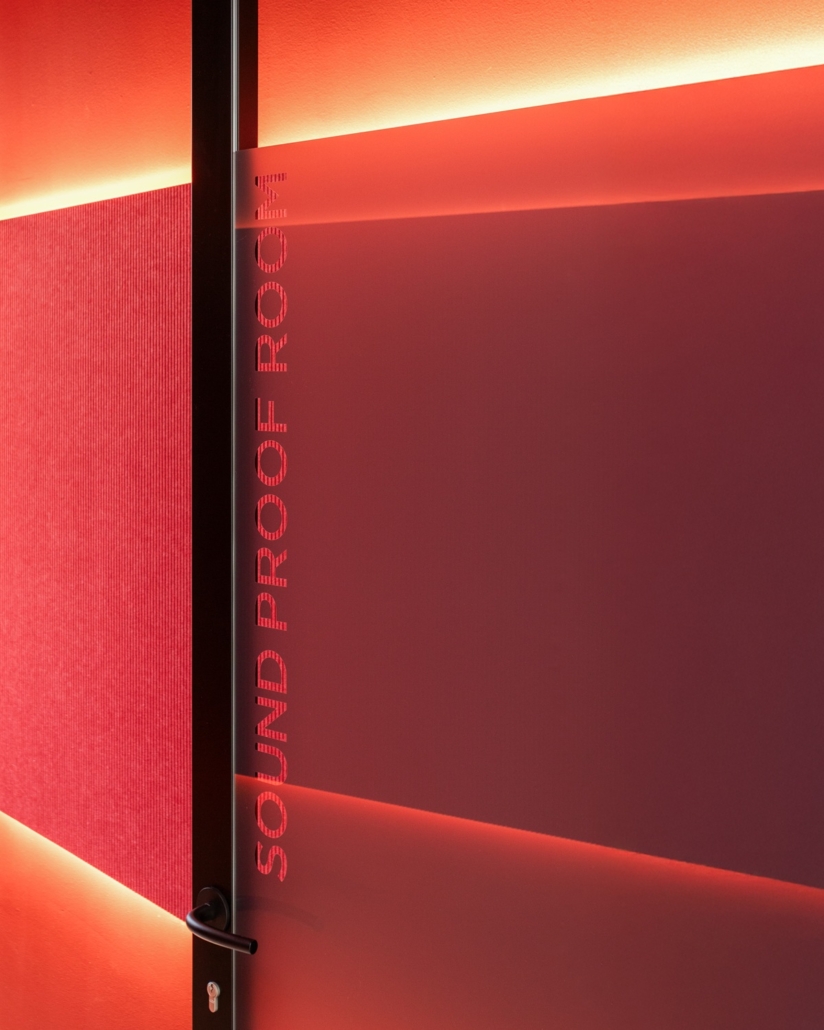
Image credit: Detail from the LEGALAB Prato project for Opera Prima Srl — Photo: © Diego Laurino Photographer
This is exactly where LvB Italia‘s solutions make a real difference. Custom sound-absorbing panels cut down reverberation and boost privacy. Vertical surfaces, for example, can be fitted with LVB SOTTOFONDO RIGIDO sound-absorbing panels — as in a soundproof meeting room designed for maximum confidentiality and acoustic comfort, where a “V-cut grooved” finish delivered a double win: better acoustic performance and a strong aesthetic identity.
Thanks to the quality of the absorbing materials and precision design, LvB Italia panels “dry out” a space by soaking up unwanted sound reflections. By reshaping the physics of the room, they shrink what’s known as the “distraction radius” — the distance a voice can travel undisturbed between desks or down a corridor. The panels deliver certified sound absorption coefficients (αw) in Class A and B under ISO 11654, guaranteeing a measurable drop in STI in treated spaces.
Solutions for Every Part of the Office
LvB Italia’s range covers the full spectrum of workplace acoustic challenges, with products designed to tackle the most common issues head-on:
- Wall and ceiling panels: ideal for open-plan offices and meeting rooms, such as the rectangular QUARTETTO panels. Available in 3 cm or 5 cm thicknesses and custom sizes (including over 240 × 120 cm). They can be wall-mounted or suspended from the ceiling on adjustable cables, so you can fine-tune height and angle to suit the space.
- Desktop panels (instant acoustic barriers): the OPERETTA is a double-sided panel with universal desk clamps, perfect for creating an instant sound barrier between neighbouring workstations. It’s especially effective at cutting lateral speech transmission and protecting sensitive conversations, with no fixed installation required.
- Freestanding panels (mobile dividers): the OPERA system is a modular, reconfigurable divider with weighted bases and zip connectors linking each unit. It’s ideal for screening off confidential areas — HR desks or interview rooms, for instance — either temporarily or permanently, without any structural work.
- LED-integrated panels (Notturni range): these combine acoustic correction with lighting in a single product. A smart, design-led choice for boardrooms and executive offices, where the overall feel of the room shapes how authoritative and confidential it appears.
When Panels Aren’t Enough: Sound Masking
In some settings — glass-walled meeting rooms, high-density open-plan floors, reception areas in professional practices — sound-absorbing treatment alone may not get you to your target STI. That’s where sound masking comes in: a system that introduces a controlled, artificial background sound (typically similar to the hiss of air conditioning), calibrated so that speech is only intelligible at close range.
The principle sounds counterintuitive, but it works: adding background sound reduces how much of a distant conversation can be understood, without anyone needing to raise their voice. A glass-walled meeting room treated with LvB panels and paired with a sound masking system can go from an external STI of 0.60 (clearly intelligible speech) to below 0.25 (indistinct murmur) — meeting speech privacy requirements even in the most architecturally challenging layouts.
Combined with well-planned space design and, where needed, sound masking systems, LvB Italia’s products create the right conditions for keeping office conversations private, naturally and effectively.
Looking for a complete solution for your office acoustics? Discover our approach to acoustic design.
Checklist: How to Test Your Office’s Acoustic Privacy Yourself
Here are a few simple tests to check whether your office needs improvement:
- The intelligibility test: have a colleague speak in a normal tone inside a closed room, while another person stands in an adjacent common area. If they can make out full sentences, speech privacy in your office isn’t good enough.
- The echo check: if you notice a metallic echo or reverberation that lingers (sound “bouncing” for more than half a second), your reverberation time (RT60) is too high. This means hard, reflective surfaces are amplifying sound and extending the distance over which speech stays intelligible. Before considering any passive fix, it’s worth assessing sound-absorbing treatment for the ceiling and perimeter walls.
- Air-gap check: check whether partition walls run all the way to the true ceiling or stop at the suspended ceiling. Sound often “leaks” over the top of physical barriers through these gaps.
- Distance from high-traffic areas: to gauge GDPR non-compliance risk linked to acoustic distance, measure the gap between areas where confidential information is discussed (HR offices, meeting rooms) and high-traffic or public-facing zones. If that distance is under 3-4 metres without effective sound-absorbing barriers in place, passive acoustic protection is inadequate — creating a real risk of conversations being overheard and a potential GDPR breach. In that case, redesigning the layout or installing sound-absorbing elements (divider panels, fibre partitions) to boost attenuation becomes necessary.
After the Checklist: Next Steps
If one or more of these checks flagged an issue, the essential next step towards protecting confidential communications is an instrumental STI (Speech Transmission Index) measurement, carried out by an acoustic professional. Only this can quantify the actual risk and correctly scope the remediation work needed.
LvB Italia is the ideal partner for businesses, law firms and healthcare facilities at every stage — from initial acoustic assessment, through bespoke solution design, to the installation of certified products and systems. To find out more about how we safeguard acoustic privacy, discover our approach to acoustic design. For a preliminary assessment or specialist advice, get in touch — no obligation.