
Sound absorption vs. Acoustic Insulation
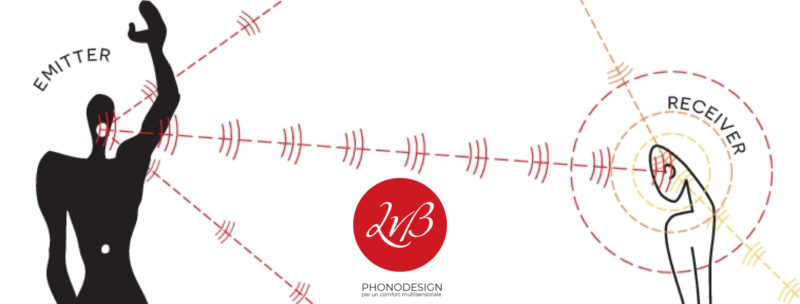
We are often asked to calculate the level of sound absorption required for an environment, only to later discover that the real issue is not the noise within the space itself, but the noise coming from outside.
It is therefore appropriate to clarify the crucial difference between sound absorption and sound insulation.
Let’s start from the fact that noise, by definition, is an unpleasant sound — it is what prevents us from concentrating at work, from clearly hearing our interlocutor, or simply causes annoyance, to the point of becoming a significant source of discomfort and stress for people.
Noise can originate from different sources, either inside the environment in which we are or outside of it.
There are two distinct ways to manage and control noise.
The first concerns the behaviour of a building with respect to sounds coming from the outside world (or from neighbouring dwellings); we refer to this concept as sound insulation.
The second concerns the acoustic characteristics of the environment in which one lives — how it reacts to internal sound sources. In this case, we speak of sound absorption.
Let’s differentiate the two phenomena and their respective solutions:

SOUND INSULATION
When disturbing noises from areas outside the analysed environment pass through walls and floors —whether through airborne transmission (for example, when voices are heard) or structural transmission (vibrations caused by impacts such as footsteps from an upstairs neighbour) — they must be properly identified and corrected.
Sound insulation consists in interposing a barrier to the transmission of sound energy from one environment to another, acoustically isolating a space from external sounds and vice versa.
Since sound propagates in different ways from one room to another, the actions required to counteract this transmission must also reflect this diversity.
For effective sound insulation, the necessary measures must be planned during the design phase and implemented during the building’s construction, as they act directly on the structural elements of the building – the very medium through which sound propagates.
SOUND ABSORPTION
Sound absorption, which we have already discussed, solves the problem of reverberation (the acoustic phenomenon linked to the reflection of a sound wave by an obstacle placed in front of the sound source) inside spaces.
Hard surfaces within an environment not only reflect sound but can even amplify it, creating considerable discomfort.
By introducing sound-absorbing materials into the environment, the acoustic quality of the space improves by intercepting and dissipating the sound energy.
The positioning of the absorbing elements within the space is crucial for the effectiveness of sound absorption — but we will discuss this topic in another article.
LvB sound-absorbing panels act precisely on sound absorption, limiting the propagation of reflected sound waves from the materials present in the environment.
In summary:
- If the noise that bothers you comes from outside — even from an adjacent office — the recommended intervention is structural, and it can only be applied during a renovation or construction phase.
- If, instead, the discomfort is caused by background noise generated inside the environment, then you’re in the right place: what you need are sound-absorbing panels!
Now all you need to do is carry out an acoustic assessment of the environment to determine the optimal reverberation time and the amount of sound-absorbing surface required to reduce the problem effectively.