
Why Avoid Thermoforming: The Advantages of Handcrafted Acoustic Engineering
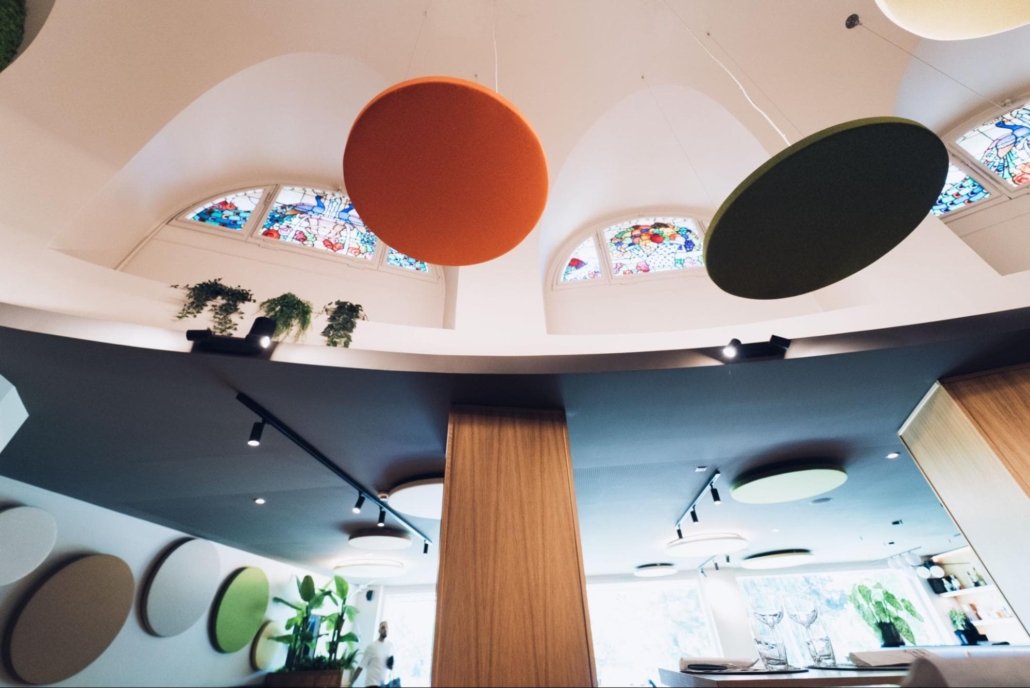
When choosing acoustic panels, not all products are created equal—even when technical spec sheets claim otherwise. The most critical difference, often overlooked during procurement, lies in the manufacturing process: industrial thermoforming vs. handcrafted free-fiber construction.
This choice is not merely aesthetic or cost-related. The thermal compression of fibers typical of mass production can reduce the sound absorption coefficient αw by 15% to 25% compared to the values listed on technical data sheets. In real-world applications, this performance loss leaves spaces reverberant despite panel installation. Understanding this distinction is the first step toward making an informed choice and achieving expected acoustic results.
The Downside of Mass Production: How Thermoforming Damages Acoustic Performance
What is Thermoforming?
Thermoforming is an industrial manufacturing method that uses heat and pressure to mold materials. While fast for mass production, applying heat-pressing to acoustic panels introduces a fundamental flaw: fiber compression.
What Happens to the Acoustics?
To achieve sharp edges or rigid molded shapes, industrial machinery compresses polyester fibers, crushing the microscopic air pockets essential for trapping sound waves. As a result, the panel becomes dense and rigid, reflecting sound instead of absorbing it.
In practice, this thermal compression can downgrade a panel’s sound absorption (coefficient αw) from a top-tier Class A (≥ 0,90) down to Class B or C (0,60-0,80). This represents a real-world performance loss of 15% to 25% compared to theoretical lab data.
A Targeted, Misleading Defect
This degradation is not uniform: heat compression selectively ruins sound absorption precisely at the frequencies critical for material porosity—specifically mid and upper-mid frequencies (500 Hz – 4 kHz). These exact frequencies dictate speech intelligibility in offices, conference rooms, and commercial spaces.
Consequently, a thermoformed panel can technically retain a Class A (αw) rating on paper while failing in everyday applications where clear speech matters most. Relying solely on a generic αw rating can be misleading, hiding disappointing acoustic performance in real-world environments.
Free-Fiber Core: Re-engineering the Process and Performance
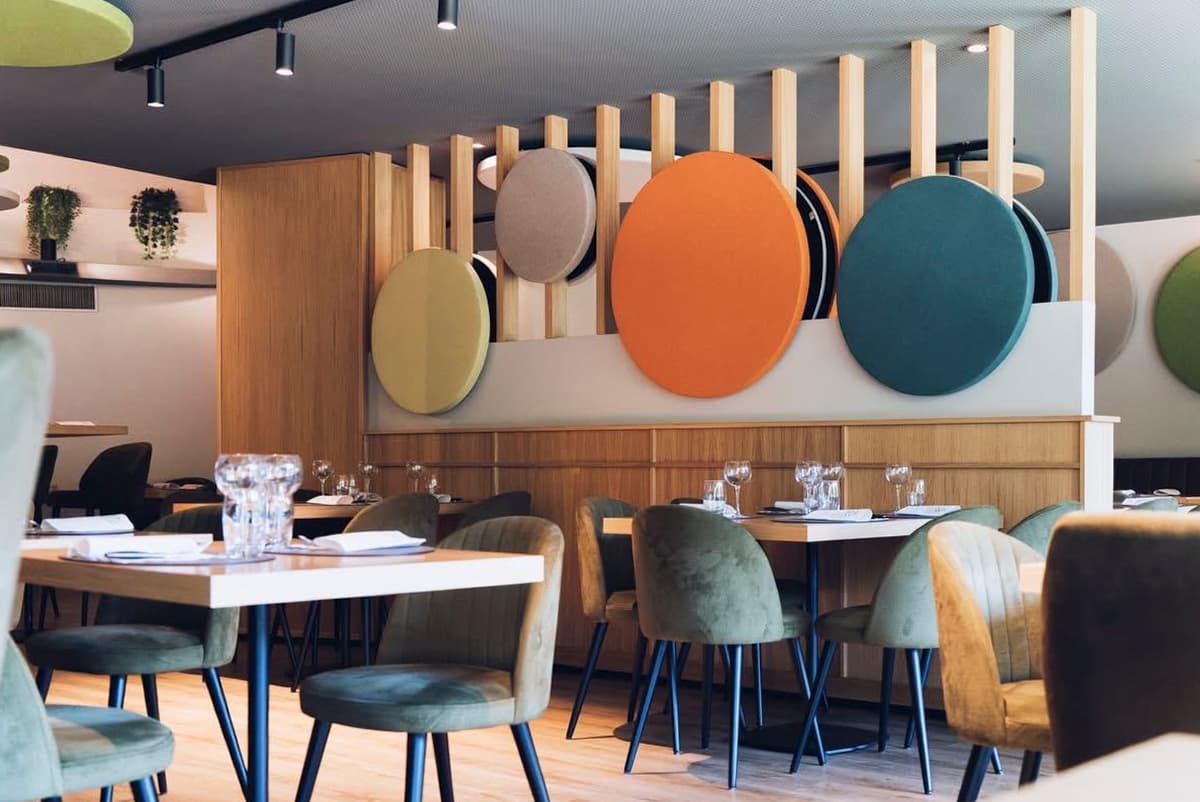
LvB Italia chooses custom craftsmanship over thermoforming, setting itself apart from cheap industrial alternatives.
By avoiding heat compression, LvB Italia manufactures acoustic panels using a free-fiber process engineered to preserve the material’s structural integrity. This method allows the polyester fiber to maintain its natural open-pore structure, delivering uniform sound absorption across the entire panel surface and linear performance across all sound frequencies.
The performance of LvB free-fiber panels is backed by hard data, not marketing claims. Absorption metrics are measured across frequency bands da 100 Hz a 5.000 Hz) according to the UNI EN ISO 354 standard in reverberation chambers at the Department of Industrial Engineering at the University of Padua.
Test results confirm that wall-offset installations consistently outperform direct-flush mountings. Starting from low frequencies, there is a measurable increase in the equivalent absorption area while maintaining stable performance across the entire spectrum—without the selective drops typical of heat-pressed panels.
Choosing custom free-fiber panels honors the physical integrity of the material, ensuring optimal technical properties to resolve reverberation in offices, restaurants, and auditoriums. A prime example is our OPERA product line—high-performance multidensity fiber acoustic panels.
By eliminating thermal compression, the density of the sound-absorbing polyester core remains 100% intact, yielding major positive impacts on the acoustic performance of custom sound-absorbing panels. The main advantages of this choice include:
- Maximum Sound Absorption: Free from compressed zones, the open porous structure allows sound waves to penetrate deep into the core and dissipate as heat energy.
- Uniform Surface Performance: The panel works evenly across its entire surface, guaranteeing consistent acoustic results across the entire installation area.
- Long-Term Durability: Unaffected by heat-pressing stress, the material retains its acoustic properties and structural shape permanently, eliminating risks of hardening, warping, or premature degradation.
Furthermore, the customization of the panels allows for striking architectural designs without sacrificing acoustic utility, such as CROMA 3D—an innovative 3D spherical acoustic panel.
Customization Without Sacrificing Acoustic Quality
Unbound by rigid press molds, it is possible to craft bespoke acoustic panels in custom sizes, thicknesses, and complex 3D shapes, without compromising acoustic performance for aesthetic appeal.
Complex 3D elements—such as spherical or relief panels, which would suffer severe acoustic degradation under industrial heat-molding—are created while preserving core fiber porosity and, consequently, sound absorption performance. For these non-planar elements, standard l’αw ratings are replaced by αobj (absorption per object) as the correct reference parameter, evaluating acoustic behavior under realistic spatial conditions. Certified αobj test data for LvB 3D panels is available upon request in our technical documentation.
Additionally, LvB panels integrate seamlessly with panels with integrated optional features: LED lighting,audio systems and dye-sublimation custom printing for logos or artwork. This demonstrates how it is possible to enrich the acoustic panel sensorially and visually without compromising its primary function. Dye-sublimation printing penetrates the fabric without sealing the weave, leaving core fiber openness and absorption coefficients completely unaffected.
Thermoformed vs. Free-Fiber: Side-by-Side Comparison
For architects, specifiers, and procurement managers evaluating acoustic solutions, this table outlines the core technical differences:
| Technical Feature | Thermoformed Industrial Panel | LvB Free-Fiber Panel |
| Real vs. Declared αw | Can drop by 15%–25% in practice | Matches certified lab ratings |
| Surface Uniformity | Dead spots near compressed edges | Uniform across entire surface |
| Mid-Low Frequency Performance | Selective dips in pressed areas | Linear absorption across all bands |
| Geometric Customization | Restricted by mold tooling | Bespoke, custom-made for each project |
| Long-Term Durability | Risk of stiffness, warping, and degradation | Stable throughout product lifespan |
| Integrated Features (LED, Audio, Prints) | Restricted by industrial molding | Integrable without performance impact |
| Eco-Certifications | Varies | Recycled PET, OEKO-TEX®, REACH, LEED, CAM |
| Acoustic Testing | Varies | UNI EN ISO 354, University of Padua |
| Frequency Response | Selective drops at critical frequencies | Linear curve across full band |
| Fire Safety Class | Varies | Class B-s2,d0 (EN 13501-1) |
| Warranty | Varies | 5 Years |
A Technical Decision Verified Over Time
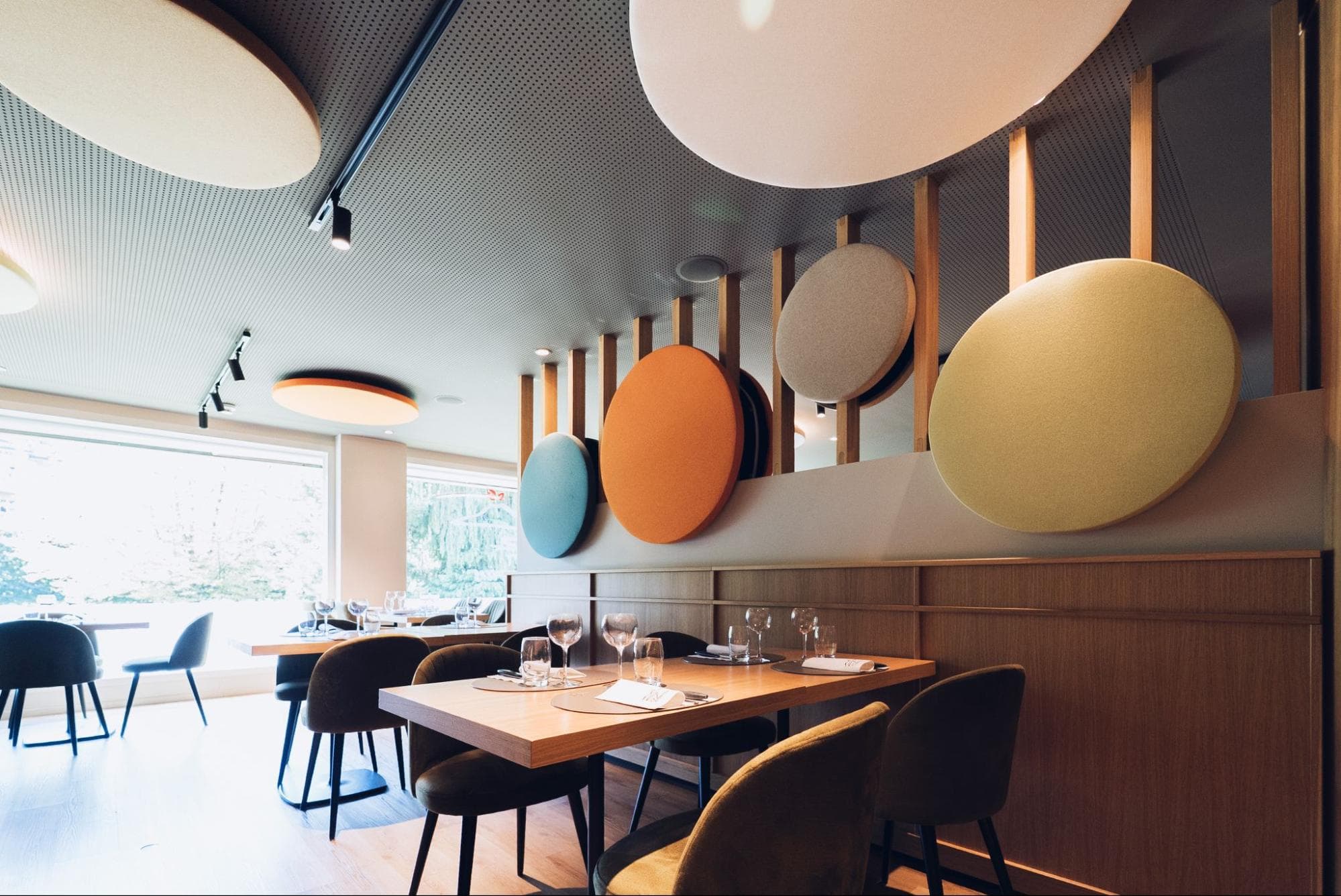
Selecting a non-thermoformed sound-absorbing panel is a verifiable technical choice—measurable with acoustic analysis tools and built to last. For a buyer justifying a premium investment or an architect writing project specifications, the difference is not subjective: it is in laboratory data and field-tested acoustics.
LvB Italia provides professionals with certified spec sheets detailing αw values per frequency band, fire-reaction classifications, and third-party laboratory test reports for every product in our catalog. If you are specifying an acoustic treatment and want to compare technical parameters against market alternatives, our engineering team is available for a direct technical review.